





By using this site, you agree to the Privacy Policy and Terms of Use.
Accept
bitcoin
Bitcoin (BTC) $ 71,413.00
ethereum
Ethereum (ETH) $ 2,111.78
xrp
XRP (XRP) $ 1.40
tether
Tether (USDT) $ 0.999978
solana
Solana (SOL) $ 88.88
bnb
BNB (BNB) $ 657.23
usd-coin
USDC (USDC) $ 0.999941
dogecoin
Dogecoin (DOGE) $ 0.096406
cardano
Cardano (ADA) $ 0.267422
staked-ether
Lido Staked Ether (STETH) $ 2,265.05
tron
TRON (TRX) $ 0.291768
chainlink
Chainlink (LINK) $ 9.17
avalanche-2
Avalanche (AVAX) $ 9.79
wrapped-bitcoin
Wrapped Bitcoin (WBTC) $ 76,243.00
wrapped-steth
Wrapped stETH (WSTETH) $ 2,779.67
the-open-network
Toncoin (TON) $ 1.32
stellar
Stellar (XLM) $ 0.163977
hedera-hashgraph
Hedera (HBAR) $ 0.095069
sui
Sui (SUI) $ 1.00
shiba-inu
Shiba Inu (SHIB) $ 0.000006
weth
WETH (WETH) $ 2,268.37
leo-token
LEO Token (LEO) $ 9.07
polkadot
Polkadot (DOT) $ 1.47
litecoin
Litecoin (LTC) $ 55.76
bitget-token
Bitget Token (BGB) $ 2.16
bitcoin-cash
Bitcoin Cash (BCH) $ 463.59
hyperliquid
Hyperliquid (HYPE) $ 36.81
usds
USDS (USDS) $ 0.999955
uniswap
Uniswap (UNI) $ 4.03
cryptoprune cryptoprune
  • MarketCap
  • Crypto Bubbles
  • Multi Currency
  • Evaluation
  • Home
  • News
  • Crypto
    • Altcoins
    • Bitcoin
    • Blockchain
    • Cardano
    • Ethereum
    • NFT
    • Solana
  • Market
  • Mining
  • Exchange
  • Regulation
  • Metaverse
Crypto PruneCrypto Prune
  • Home
  • News
  • Crypto
    • Altcoins
    • Bitcoin
    • Blockchain
    • Cardano
    • Ethereum
    • NFT
    • Solana
  • Market
  • Mining
  • Exchange
  • Regulation
  • Metaverse

Search

  • Home
  • News
  • Crypto
    • Altcoins
    • Bitcoin
    • Blockchain
    • Cardano
    • Ethereum
    • NFT
    • Solana
  • Market
  • Mining
  • Exchange
  • Regulation
  • Metaverse

Latest Stories

A bridge between crypto assets and traditional assets
image
Argentine neobank Huala raises $195 million to fund Latin American expansion
image
ITC founder talks about characteristics that define a Bitcoin bear market and why BTC is already in a bear market
image
Chainlink strengthens integration of cbtc token as first wrapped bitcoin asset on Canton Network
Hardware crypto wallet and Bitcoin coin on a bedside table as a masked intruder enters a home, illustrating rising physical security risks tied to Bitcoin self-custody for everyday investors in France
BlackRock’s new product makes Ethereum revenue impossible to ignore
© 2025 All Rights reserved | Powered by Crypto Prune
Crypto Prune > News > Crypto > Ethereum > Ethereum blockchain outperforms unique speed improvements, but has pitfalls
Ethereum

Ethereum blockchain outperforms unique speed improvements, but has pitfalls

2 months ago 4 Min Read

Ethereum, a smart contract blockchain, can now handle more day-to-day activities than cheaper side chains called layer 2 networks. However, this revival has its pitfalls. It appears that not all Ethereum activity reflects true user demand.

The number of daily active addresses on Ethereum increased towards the 1 million mark earlier this month, briefly peaking at over 1.3 million on January 16, before settling at nearly 950,000, according to data source Token Terminal.

This gave Ethereum an edge over popular scaling networks such as Arbitrum, Base, and OP Mainnet, and reversed much of the narrative that users had permanently migrated away from L1.

An active address is a unique blockchain wallet that performs transactions such as sending, receiving, or interacting with smart contracts during a specific period of time (e.g., daily). Analysts track metrics to examine actual network usage beyond token price hype.

Layer 2 scaling networks are like side streets and highways built on top of the primary blockchain highway, Ethereum. These sidechains quickly and cheaply process large amounts of transaction traffic from the main chain and send the final aggregation back to the main chain for security.
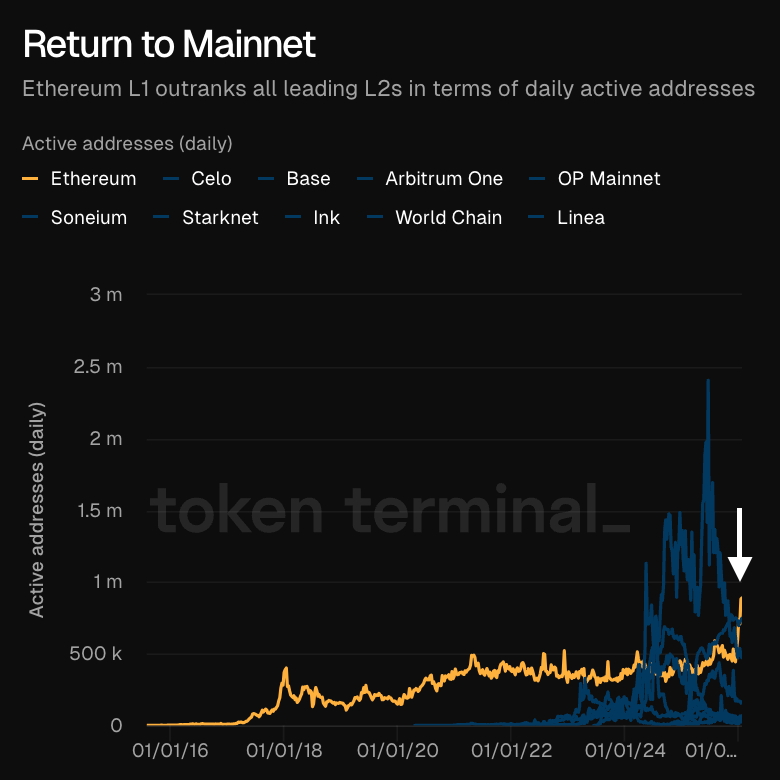
The resurgence in Ethereum activity follows the Fusaka upgrade in December, which saw transaction fees slashed, making direct trading on Ethereum cheap again. Lower costs have helped revive on-chain activity for stablecoins, especially the primary use case for day-to-day money transfers.

At face value, this number suggests a “return to mainnet” moment. But analysts warn that raw address counts can be misleading, especially if prices drop significantly and spam becomes economical.

See also  Ethereum forms long leg doji on monthly charts - inversion or just a pause?

Address addiction confuses the situation

Imagine spam calls flooding your phone. Although the call records look busy, they are mostly junk and not real conversations. Something similar is happening with Ethereum, as a significant portion of January’s address growth was related to countering poisoning attacks rather than organic adoption.

Security researcher Andrei Sergenkov said in a post earlier this week that the spike roughly coincides with an increase in dusting operations in which attackers send small stablecoin transfers to millions of wallets.

Addressing addictive behaviors that exploit human behavior. Attackers generate wallet addresses that closely resemble the victim’s real address, often with matching first and last characters.

The fake address then appears in the victim’s transaction history as they send small “dust” transfers, typically less than $1. If the victim then copies the address from that history instead of a trusted source, the funds will be mistakenly transferred to the attacker.

According to Sergenkov’s analysis, the number of new Ethereum addresses surged to about 2.7 million during the peak week of January 12, about 170% above normal levels. Approximately two-thirds of these addresses received Dust as their first stablecoin transaction. This is a strong sign of poisoning activity rather than actual onboarding.
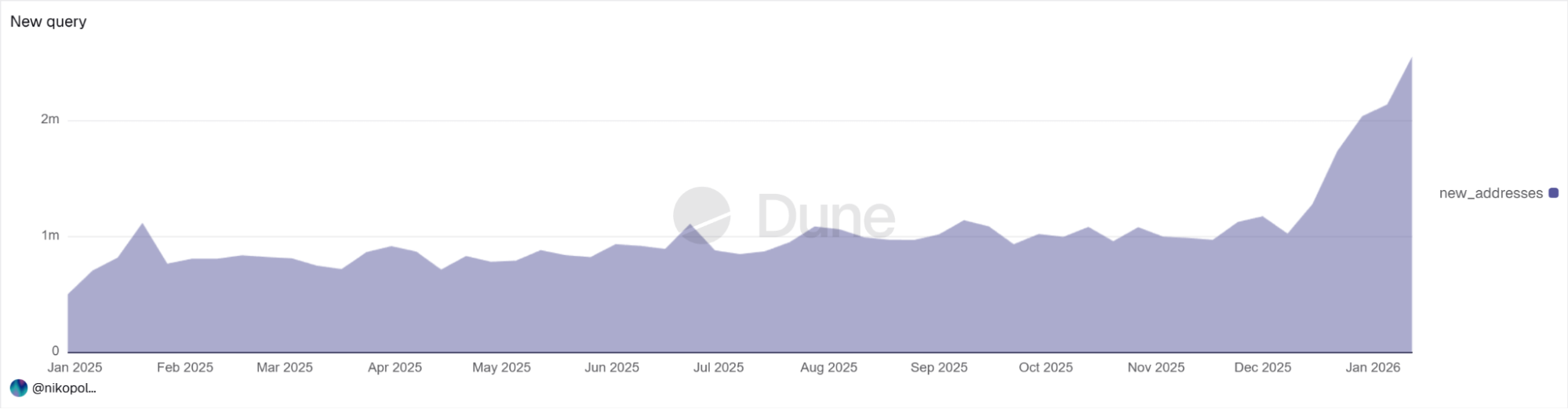
The attack has already resulted in more than $740,000 in losses, with most of the stolen funds coming from a small number of victims. Lower fees following Fusaka appear to have made these campaigns viable, allowing attackers to spray large transactions with limited upfront costs.

The point is not that Ethereum usage is bogus, but that headline metrics need context.

See also  Ethereum is becoming a "master ledger" for finance, says co-founder Joseph Rubin.

It is clear that stablecoin activity in particular has returned to mainnet due to lower fees. At the same time, cheap transactions enable abuse and increase the number of addresses and transaction volumes.

TAGGED:EthereumEthereum News
Leave a comment Leave a comment

Leave a Reply Cancel reply

Your email address will not be published. Required fields are marked *

RELATED NEWS

Bitfinex-Backed Plasma Protects EtherFi Partnerships with $500 Million ETH Vault Integration

Bitfinex-Backed Plasma Protects EtherFi Partnerships with $500 Million ETH Vault Integration

By Crypto Prune 7 months ago
Ethereum price signal rises as ETF win streak continues

Ethereum price signal rises as ETF win streak continues

By Crypto Prune 9 months ago
Chainproof "thrashing" losses that fight Ethereum to guarantee annual yields

Chainproof “thrashing” losses that fight Ethereum to guarantee annual yields

By Crypto Prune 10 months ago
Ethereum surpasses Bitcoin once the institutional inflows in July reaches its record.

Ethereum surpasses Bitcoin once the institutional inflows in July reaches its record.

By Crypto Prune 8 months ago
cryptoprune

© 2025 All Rights reserved | Powered by Crypto Prune

  • Altcoins
  • Bitcoin
  • Blockchain
  • Cardano
  • Ethereum
  • Exchange
  • Market
  • Metaverse
  • Mining
  • News
  • Crypto
  • NFT
  • Solana
  • Regulation
  • Technology
  • About Us
  • Contact Us
  • Disclaimer
  • Privacy Policy
  • Terms of Service
Welcome Back!

Sign in to your account

Lost your password?