








US President Donald Trump announced in his State of the Union address that major technology companies specializing in artificial intelligence must meet their own energy needs by building their own power plants.
The Feb. 24 announcement comes in response to growing concerns since January 2026, when U.S. household electricity prices rose 6.7% year over year. According to the White House, National network described by president as “old and overburdened”it is not possible to absorb AI consumption without passing on the expansion costs to the population.
We tell them that they have an obligation to meet their needs. They can build their own factories as part of their facilities so that prices don’t go up for anyone. Our old power grid cannot handle that amount of power.
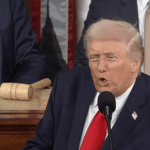
Donald Trump in the US Congress.
Although President Trump did not explicitly mention Bitcoin mining, as CriptoNoticias reports, the Ratepayer Protection Pledge effectively affects many facilities that combine AI and digital mining. That’s because these facilities share the same energy-intensive infrastructure.
This model is already being applied by companies such as TeraWulf, which operates a 200 megawatt (MW) facility directly connected to a nuclear power plant in Pennsylvania, and Marathon Digital, which manages projects with self-generated energy.
The urgency of this agreement can be seen by looking at the numbers for the sector. Research shows that a medium-sized AI data center consumes 50-100 MW. This is roughly equivalent to the electricity consumption of 40,000 to 80,000 average U.S. homes (per 100 MW, as estimated by the Congressional Research Service and IEA).
In the current system, A single large technical installation can double or triple the load on a local substationThis requires infrastructure upgrades, which are typically funded by community-wide electricity rate increases.
Three key barriers identified
But the proposal leaves open questions that were not elaborated in the speech. Some energy sector experts point to three significant obstacles that could affect the success of this announcement.
First is the execution deadline. This takes into account that building a power plant (whether modular nuclear, gas, or renewable energy) requires a permitting and construction process that typically takes more than 5 to 10 years. This suggests that relief will not come soon.
Second, the “paradox of utility” is presented. This takes into account: Companies could be forced if big tech companies stop buying energy from local suppliers. Raise household rates to cover the fixed costs of maintaining existing infrastructure and spread them over fewer customers.
In third place is the issue of backup security, but it is not clear whether these companies will be prohibited from connecting to the public grid in the event of an emergency, a common point of friction in regulating private power generation.
So far, companies such as Microsoft and Amazon that have invested in nuclear and renewable energy for their data centers have not issued public statements confirming the terms of their commitments. White House sources quoted by Reuters and Politico confirmed that an agreement had been reached before the speech. It is unclear whether it includes a sanction mechanism for violations.
President Trump’s speech lasted one hour and 47 minutes, making it the longest State of the Union address in the country’s history, and focused primarily on energy sovereignty. But federal regulators reminded that the deal does not change state or federal electricity generation regulations, meaning companies still have to navigate a complex web of zoning laws and environmental standards.
The effectiveness of consumer protection commitments therefore depends on the government’s ability to expedite permits for new power plants. Otherwise, the ambition to lead in artificial intelligence Electricity bills may remain the same or even increase For residential consumers.