








How did a lone Bitcoin miner beat 1 in 10 million odds to find a block worth $347,000? And what does it reveal about solo mining in 2025?
summary
- A Reddit user claimed to have independently mined Bitcoin block 920440 using an Umbrel Mini and earned approximately $347,000 in rewards and fees.
- Blockchain data supported this claim, showing no trace of the proprietary Coinbase tag and large mining pools being involved.
- At current network levels of more than 1 zettahash per second, the probability that a single miner will find a block is approximately 1 in 10 million.
- Industrial-scale pools currently control about 75-85% of global production, making standalone mining in 2025 more of an experiment than a profit source.
table of contents
Solo miner claims to have won Bitcoin in rare cases
A recent post on Reddit’s r/Bitcoin community caught the attention of miners around the world. One user claimed to have mined a Bitcoin block completely on his own without any support from a large mining pool.
This block was numbered 920440 and included a standard reward of 3.125 Bitcoin (BTC) plus transaction fees, which was equivalent to approximately $347,000 at the time.
Mining Bitcoin blocks involves solving cryptographic puzzles that require vast amounts of computing power. Each miner repeatedly tests a random number, known as a nonce, until it generates a hash that meets the network’s target difficulty.
The difficulty level is automatically adjusted to ensure that a new block is discovered approximately every 10 minutes, regardless of the number of competing miners. Solo miners work independently and maintain both risk and full reward, making this process highly unpredictable.
Currently, large mining pools dominate the network. A small home miner running only a few machines will contribute just a few terahashes and the odds of finding a block are as low as 1 in 200 million.
Still, it’s not entirely impossible. CKPool, a platform that allows independent miners to work alone without sharing rewards, has recorded some rare wins over the past decade.
A Reddit user said he was using an Umbrel Mini device for mining and was stunned to see a “block found” message appear on the screen. Community members flooded the thread with congratulations, but some urged it to be verified with blockchain data before celebrating.
Blockchain data matches Reddit’s claims
Every Bitcoin block is publicly available, with exact details such as the time it was mined, the entity doing the mining, the difficulty level, and the total reward earned. When we investigated block 920440, we found that its characteristics closely matched the accounts of Reddit users.
This block was mined on October 23rd at 19:32 UTC and contained a short text note known as the Coinbase tag that reads “Public Pool on Umbrel.”
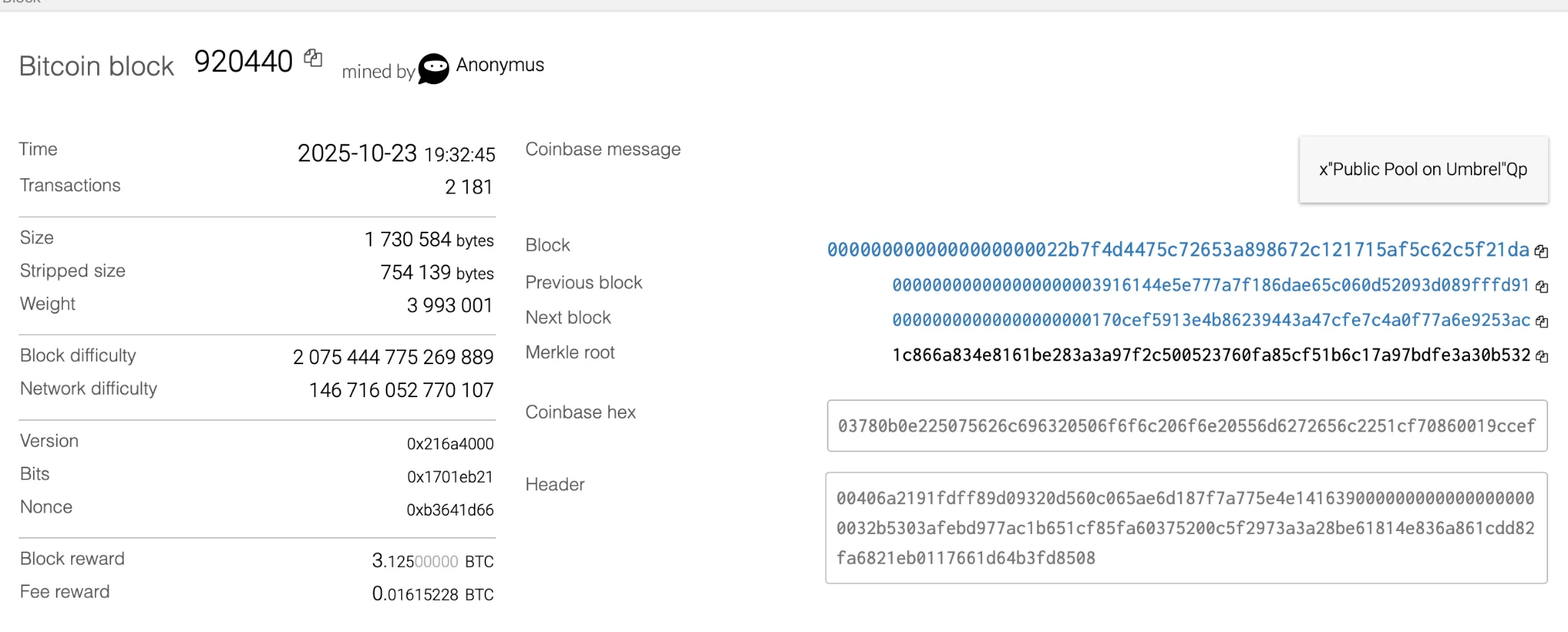
On-chain data for block 920440 | Source: Bitaps
This tag, inserted by the miner’s software, identified the setup responsible for generating the block and matched the Reddit user’s claim that it mined through a public pool on the Umbrel Mini device.
No major commercial pool uses that tag. Blocks mined by major operators such as Foundry USA, F2Pool, and AntPool will have their names clearly displayed within Coinbase messages.
The lack of these names and the presence of custom tags suggests that this block was actually mined by an individual rather than a pool.
Raw network data shows how rare that event was. The block difficulty was approximately 2.07 trillion, while the total network difficulty remained close to 146 trillion.
At that level, a home miner producing 1 terahash per second would have to mine for hundreds of millions of years on average before finding a block.
Still, probabilities can yield improbable outcomes. Bitcoin’s Proof-of-Work mechanism ensures that participants, no matter how small, have a measurable chance of success.
There was nothing wrong with the block itself. This included over 2,100 transactions, approximately 89% of which used SegWit, which is consistent with normal network behavior.
Taken together, all technical indicators point to one conclusion. It appears that a miner running a solo Umbrel-based setup did indeed mine block 920440, defying astronomical odds.
Why solo mining is almost impossible
Mining Bitcoin blocks may sound like a level game, but the scale at which it is being done today tells a completely different story. All miners in the network are trying to solve the same cryptographic puzzle, but their tools, costs, and chances of success vary widely.
Home miners usually start small. A setup may include one or two machines known as ASICs, short for Application-Specific Integrated Circuits.
The ASIC is built to perform the single task of solving Bitcoin’s proof-of-work equation. Each ASIC can perform trillions of calculations per second, but even that level of power is tiny compared to the global network.
As of October 27th, the entire Bitcoin network is operating at approximately 1.035 zettahashes per second. This means that we are performing more than 1 sextillion (10²¹) calculations every second.
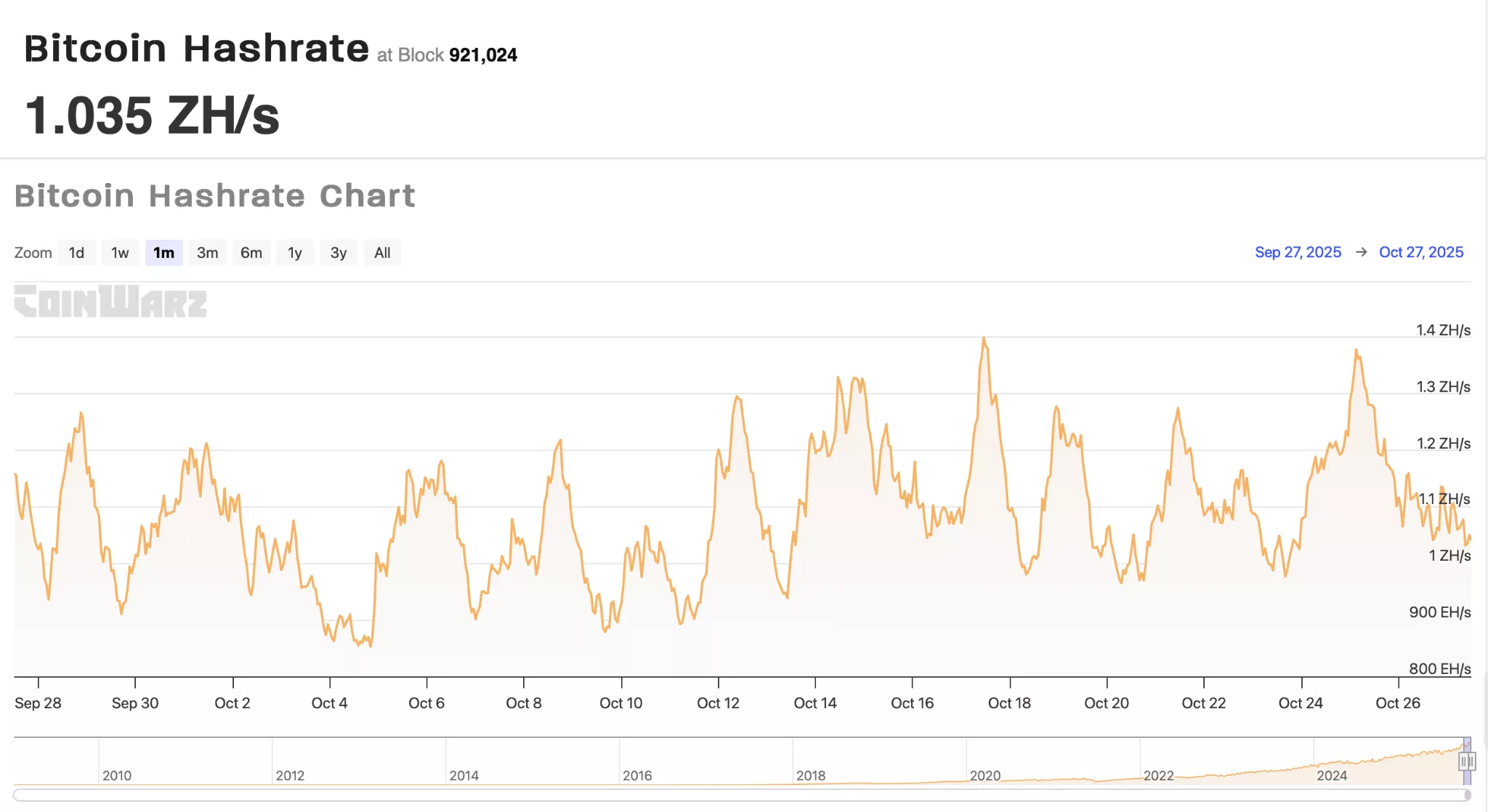
Bitcoin Hash Rate Chart |Source: Coinwarz
According to one calculation, if the network remains at its current level and runs a top ASIC producing 234 terahashes per second, the probability of finding a block within a 10-minute window is approximately 0.0000222%, or 2.2 in 10 million.
Because each ASIC consumes large amounts of energy and continually emits heat, miners invest heavily in cooling systems to prevent hardware damage and maintain efficiency.
To offset these costs, miners prefer regions where renewable or surplus energy is available and electricity prices are very low, such as parts of Texas, Kazakhstan, and Iceland.
Carriers in these regions buy hardware in bulk, sometimes thousands of units at a time, secure long-term power contracts, and use real-time monitoring systems to manage power loads and maintain performance stability.
As their operations expand, many large miners choose to combine their computing power through mining pools, where thousands of participants contribute resources and receive small but steady payments, instead of waiting for rare full-block rewards.
In 2025, almost the entire hashrate of the network will be concentrated in a few large pools such as Foundry USA, Antpool, F2Pool, and ViaBTC.
Together, these top five account for about 75-85% of global block generation at any given time, with smaller or unidentified pools handling the rest, according to data from public trackers.
The role of home miners is statistically negligible. In Bitcoin’s history, only a few hundred solo-mined blocks have been recorded, showing how extremely rare it is for individual miners to independently find blocks.
If you pay standard residential rates, home mining is rarely profitable unless someone gets very lucky and discovers a block.
Simply put, nearly every block on today’s networks is generated by large-scale professional operations, but independent works like the Umbrel Mini case remain rare exceptions.
Anyone considering home mining in 2025 should treat it as a practical experiment rather than an investment. While this provides insight into how Bitcoin stays secure and decentralized, it is not a reliable path to income.