






By using this site, you agree to the Privacy Policy and Terms of Use.
Accept
bitcoin
Bitcoin (BTC) $ 92,009.65
ethereum
Ethereum (ETH) $ 3,158.65
xrp
XRP (XRP) $ 2.10
tether
Tether (USDT) $ 1.00
solana
Solana (SOL) $ 137.13
bnb
BNB (BNB) $ 908.56
usd-coin
USDC (USDC) $ 1.00
dogecoin
Dogecoin (DOGE) $ 0.143253
cardano
Cardano (ADA) $ 0.433277
staked-ether
Lido Staked Ether (STETH) $ 3,157.03
tron
TRON (TRX) $ 0.286984
chainlink
Chainlink (LINK) $ 14.15
avalanche-2
Avalanche (AVAX) $ 13.77
wrapped-bitcoin
Wrapped Bitcoin (WBTC) $ 91,951.64
wrapped-steth
Wrapped stETH (WSTETH) $ 3,849.12
the-open-network
Toncoin (TON) $ 1.66
stellar
Stellar (XLM) $ 0.244258
hedera-hashgraph
Hedera (HBAR) $ 0.136039
sui
Sui (SUI) $ 1.64
shiba-inu
Shiba Inu (SHIB) $ 0.000008
weth
WETH (WETH) $ 3,155.47
leo-token
LEO Token (LEO) $ 9.72
polkadot
Polkadot (DOT) $ 2.16
litecoin
Litecoin (LTC) $ 83.61
bitget-token
Bitget Token (BGB) $ 3.57
bitcoin-cash
Bitcoin Cash (BCH) $ 600.90
hyperliquid
Hyperliquid (HYPE) $ 30.65
usds
USDS (USDS) $ 1.00
uniswap
Uniswap (UNI) $ 5.70
cryptoprune cryptoprune
  • MarketCap
  • Crypto Bubbles
  • Multi Currency
  • Evaluation
  • Home
  • News
  • Crypto
    • Altcoins
    • Bitcoin
    • Blockchain
    • Cardano
    • Ethereum
    • NFT
    • Solana
  • Market
  • Mining
  • Exchange
  • Regulation
  • Metaverse
Crypto PruneCrypto Prune
  • Home
  • News
  • Crypto
    • Altcoins
    • Bitcoin
    • Blockchain
    • Cardano
    • Ethereum
    • NFT
    • Solana
  • Market
  • Mining
  • Exchange
  • Regulation
  • Metaverse

Search

  • Home
  • News
  • Crypto
    • Altcoins
    • Bitcoin
    • Blockchain
    • Cardano
    • Ethereum
    • NFT
    • Solana
  • Market
  • Mining
  • Exchange
  • Regulation
  • Metaverse

Latest Stories

image
Altcoins now account for 60% of Binance’s circulation, overtaking BTC and ETH
Sudden $13.5 billion liquidity injection by the Fed reveals cracks in the dollar that Bitcoin was built on
Coinbase's logo on a phone in front of crypto prices
Coinbase resumes user onboarding in India, plans to introduce fiat currency next year
Coinbase
Coinbase Premium in Crisis — Analysts Highlight What It Suggests for Bitcoin
What happened to Ethereum after Fusaka arrived?
© 2025 All Rights reserved | Powered by Crypto Prune
Crypto Prune > News > Crypto > Ethereum > Concerns about DeFi instability risks rise as Ethereum staking delays increase
Ethereum

Concerns about DeFi instability risks rise as Ethereum staking delays increase

2 months ago 5 Min Read

Ethereum’s staking network is under increasing strain as validator withdrawals reach record levels, testing the system’s balance between liquidity and network security.

According to recent validator data, as of October 8, over 2.44 million ETH worth over $10.5 billion was pending withdrawal, the third highest level in a month.

This backlog is only lower than the peak of 2.6 million ETH recorded on September 11th and 2.48 million ETH recorded on October 5th.

According to Dune Analytics data curated by Hildobby, withdrawals are concentrated on major Liquid Staking Token (LST) platforms such as Lido, EtherFi, Coinbase, and Kiln. These services allow users to stake ETH while maintaining liquidity through derivative tokens such as stETH.
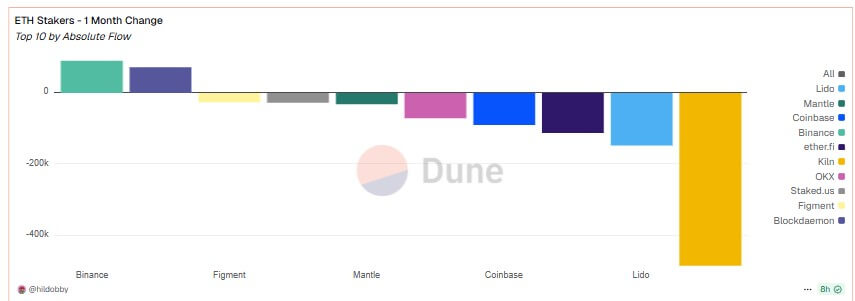
As a result, ETH stakers currently face withdrawal delays of 42 days and 9 hours on average. This reflects the imbalance that has been going on since ETH. crypto slate We first identified the trend in July.

Notably, Ethereum co-founder Vitalik Buterin defended the withdrawal design as an intentional safety measure.

He compared staking to a disciplined form of service to the network, arguing that delayed exits discourage short-term speculation and strengthen stability by ensuring validators remain committed to the long-term security of the chain.

What impact does this have on Ethereum and its ecosystem?

The long withdrawal queues have sparked debate within the Ethereum community, fueling concerns that they could represent a systemic vulnerability in the blockchain network.

Anonymous ecosystem analyst Rob Dog called the situation a potential “ticking time bomb” and noted that longer exit times amplify duration risk for participants in the liquidity staking market.

See also  Ethereum Openless Top 24.5 b as traders chase the rally

he said:

“The problem is that this could cause a vicious unwinding loop, with huge implications for DeFi, lending markets, and the use of LST as collateral.”

According to Robdog, queue length directly impacts the liquidity and price stability of tokens like stETH and other liquid staking derivatives, which typically trade at a slight discount to ETH to reflect redemption delays and protocol risks. However, these discounts tend to get deeper as the validator queue gets longer.

For example, if stETH is trading at 0.99 ETH, a trader can earn around 8% per year by buying the token and waiting 45 days for redemption. However, if the lag period were doubled to 90 days, the incentive to buy the asset would drop to around 4%, potentially widening the peg gap further.

Additionally, stETH and other liquidity staking tokens are collateral across DeFi protocols such as Aave, so any significant deviations from the price of ETH can ripple through the broader ecosystem. For context, Lido’s stETH alone has around $13 billion in total locked up, much of it tied to leveraged loop positions.

Robdog warned that a sudden liquidity shock, such as a large deleveraging event, could force a rapid unwinding, raising borrowing rates and destabilizing the DeFi market.

He wrote:

“For example, if market conditions suddenly change and many ETH holders want to rotate their positions (e.g. another Terra/Luna or FTX level event), a significant withdrawal of ETH will occur. However, as the majority is lent out, only a limited amount of ETH can be withdrawn. This could lead to a run.”

In view of this, analysts warned that the safe and lending markets require a stronger risk management framework given the increased duration exposure.

See also  Ether was preferred for a lot of money over bitcoin, here are three clues pointing to the ETH bias in the crypto market

According to him:

“If an asset’s exit period spans from one day to 45 days, it is no longer the same asset.”

He also urged developers to consider the discount rate for the period when pricing collateral.

Londog writes:

“LST is fundamentally a useful and systematic infrastructure for DeFi, so you should consider upgrading the throughput of your exit queue. Even if you increase the throughput by 100%, you will still have enough benefits to secure your network.”

TAGGED:EthereumEthereum News
Leave a comment Leave a comment

Leave a Reply Cancel reply

Your email address will not be published. Required fields are marked *

RELATED NEWS

image

Republic $DOCT secures $100 million in interest-free financing to expand Ethereum staking operations

By Crypto Prune 4 weeks ago
Bitcoin vs Ethereum

Data may suggest that Ethereum prices are more affected by the off-chain market than Bitcoin

By Crypto Prune 3 months ago
Ethereum

Vitalik Buterin proposes “simplified” Ethereum, like Bitcoin. detail

By Crypto Prune 7 months ago
"Why ETH is $10,000," explains EMJ Capital's founder and president

“Why ETH is $10,000,” explains EMJ Capital’s founder and president

By Crypto Prune 5 months ago
cryptoprune

© 2025 All Rights reserved | Powered by Crypto Prune

  • Altcoins
  • Bitcoin
  • Blockchain
  • Cardano
  • Ethereum
  • Exchange
  • Market
  • Metaverse
  • Mining
  • News
  • Crypto
  • NFT
  • Solana
  • Regulation
  • Technology
  • About Us
  • Contact Us
  • Disclaimer
  • Privacy Policy
  • Terms of Service
Welcome Back!

Sign in to your account

Lost your password?