









Ethereum’s Fusaka upgrade is currently live on mainnet and brings major structural changes to the way the network handles data and scales. The upgrade was activated at 21:49:11 UTC on epoch 411392, and the official Ethereum account first announced “Upgrading . . Activating Fusaka @ epoch 411392 // 21:49:11 UTC” and then confirmed “Fusaka is live on Ethereum mainnet!”
In the announcement, the account highlighted three core elements of Fusaka. PeerDAS “unlocks rollup data throughput by 8x,” significantly expanding the amount of data rollup-based Layer 2 networks can expose to the network. This upgrade also introduces “UX improvements with R1 curves and prechecks” and is explicitly described as “preparing for L1 scaling, including increased gas limits.” The project added that community members and core developers will “continue to monitor the issue over the next 24 hours.”
Why Fusaka is “important” to Ethereum
Vitalik Buterin explained the core of the upgrade in unusually direct terms. “Fusaka’s PeerDAS is important because it is literally sharding,” he wrote. “Ethereum is reaching consensus on blocks without the need for a single node to see more than a small portion of the data, and this is robust to 51% attacks. This is client-side probabilistic validation rather than voting by validators.” In other words, the network can now rely on client-side probabilistic validation instead to reach consensus on blocks even when no node has downloaded all the relevant data.
Buterin tied this to a long line of research, noting that “sharding has been an Ethereum dream since 2015 and data availability sampling has been an Ethereum dream since 2017,” linking it to early research work on data availability and erasure coding. With the introduction of Fusaka, its architecture is no longer just a roadmap concept, but a live mechanism to secure Ethereum’s data layer.
At the same time, Buterin was clear that Fusaka had not completed the sharding roadmap. He emphasized that “Fusaka’s sharding is incomplete for three reasons.” First, he claims that “L2 can handle O(c^2) transactions (c is per-node compute), whereas Ethereum L1 cannot,” adding, “If we want to scale to benefit Ethereum L1 beyond what constant upgrades like BAL and ePBS can provide, we need a mature ZK-EVM.”
Second, he pointed to the “proponent-to-builder bottleneck,” noting that “the constructor needs to have the entire data to build the entire block,” and said, “It would be great to have distributed block construction.” Third, he stated bluntly: “We don’t have a sharded menpool. We still need it.”
Despite these caveats, Buterin called Fusaka “a fundamental step forward in blockchain design.” He claimed that “the next two years will give us time to refine the PeerDAS mechanism, carefully scale it while continuing to ensure its stability, use it to expand L2, and once ZK-EVM matures, turn it inward to expand Ethereum L1 gas as well.”
He congratulated the Ethereum researchers and core developers who have worked for years to make this a reality, and concluded by emphasizing that for the Ethereum community, Fusaka is not just a regular protocol update, but the arrival of the long-promised era of mainnet sharding.
At the time of writing, ETH was trading at $3,194.
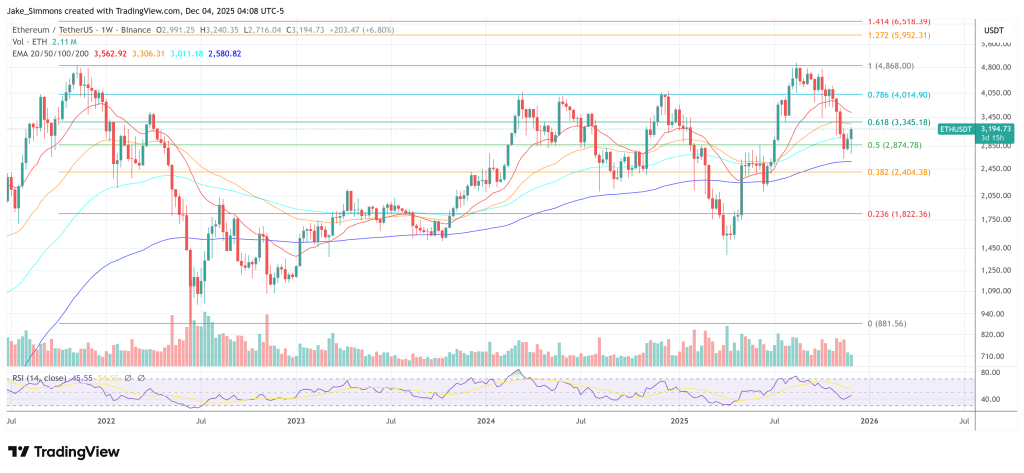
Featured image created with DALL.E, chart on TradingView.com
editing process for is focused on providing thoroughly researched, accurate, and unbiased content. We adhere to strict sourcing standards, and each page is carefully reviewed by our team of top technology experts and experienced editors. This process ensures the integrity, relevance, and value of your content to your readers.