









Amina, a Swiss regulated crypto bank, has joined the blockchain-based payments platform for tokenized securities operating under the European Union’s DLT pilot, taking another step towards the integration of digital asset infrastructure and traditional capital markets.
The Zug, Switzerland-based firm announced on Monday that it has become the listing sponsor of the EU-regulated platform 21X, making Amina the first bank participant in the fully regulated venue.
Amina said the move will enable it to support companies issuing tokenized securities on 21X through a partnership with Tokeny, a Luxembourg-based company that provides technology for the creation and management of tokenized financial assets.
The partnership aims to address key barriers to institutional adoption of tokenized assets by linking regulated banks with the issuance and trading of tokenized securities.
21X received infrastructure approval under the EU’s DLT pilot scheme in December 2024, allowing it to operate a regulated market for blockchain-based securities in a regulated test environment.
“Lack of interoperability of tokenized asset platforms” was cited by Baker McKenzie’s European Financial Services practice in June as one of the main obstacles to the adoption of tokenization in financial institutions. “Scale is only achieved when a large number of market participants trade with each other on a common or interconnected platform,” Zurich partner Yves Maukl said on the firm’s blog.
The DLT framework, introduced in 2023, will allow market operators to experiment with blockchain-based trading and settlement of financial instruments within a regulatory sandbox. The program is intended to help regulators assess how this technology can fit into existing market infrastructure.
Despite its early introduction, the regime has come under intense scrutiny from industry players, who warn that current restrictions could hinder the expansion of Europe’s on-chain market and competition with other jurisdictions. It remains to be seen whether the participation of regulated banks like Amina will help accelerate adoption.
Related: Tokenized goods market rises to $7.7 billion, crypto exchanges rise
Strong growth in tokenized real-world assets
This development comes as financial institutions increase investment in blockchain infrastructure for tokenized assets. In the US, financial institutions such as BNY, Nasdaq and S&P Global have recently supported the expansion of canton networks, while in Europe they are testing regulated blockchain trading venues such as 21X under the EU’s DLT pilot regime.
In February, eight EU-regulated digital asset companies warned that the EU risks falling behind the United States and other jurisdictions in developing tokenized financial markets, and called on policymakers to accelerate digital asset legislation.
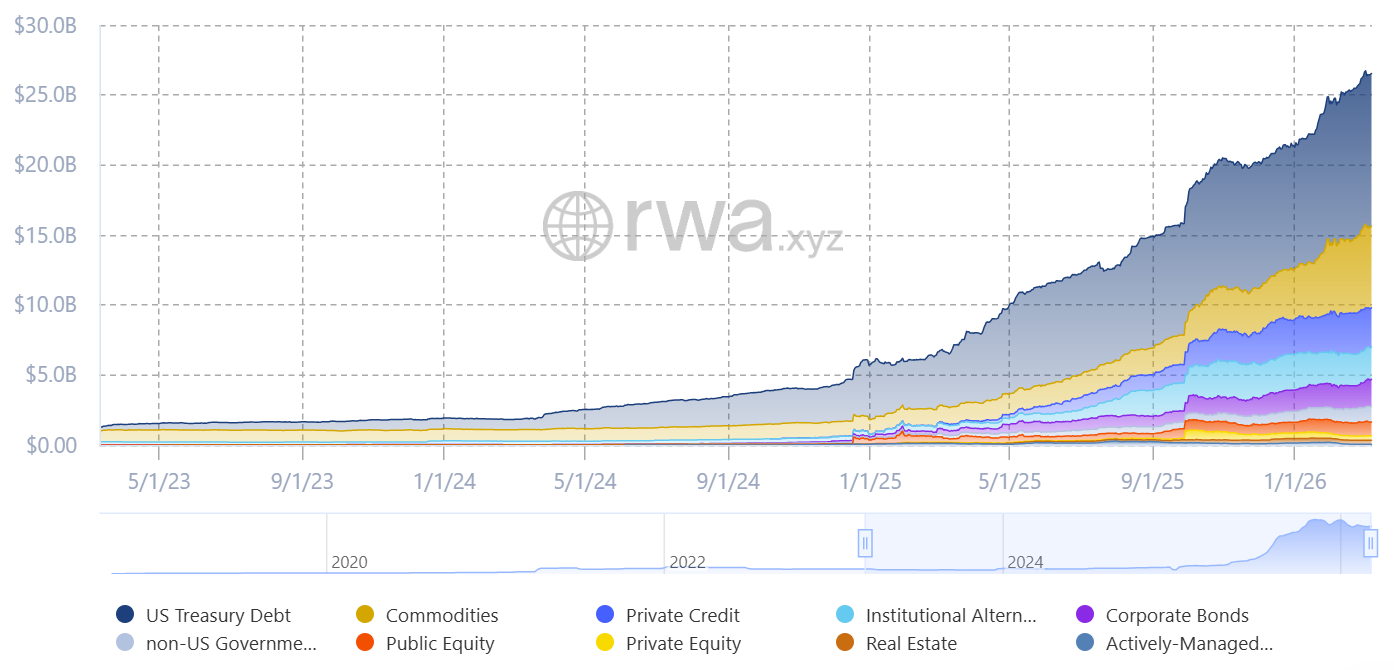
The total amount of tokenized real-world assets reached $26.5 billion. sauce: RWA.xyz
Indeed, positive developments are occurring. In September, cryptocurrency exchange Kraken launched tokenized securities trading for users in Europe through its xStocks platform, which offers blockchain-based versions of US-listed stocks.
Two months later, tokenization platform Ondo received Liechtenstein regulatory approval to offer tokenized stock trading to European investors.
Related: Cryptobiz: Kraken connects to Fed