









Bitcoin mining difficulty will drop to just over 146 trillion in the network’s first difficulty rebalance in 2026, providing a small but measurable relief for miners. The adjustment, completed in early January, lowered the index from its end-2025 level, according to multiple reports.
Initial adjustments provide temporary relief
At the time of the change, the average block time across the network was nearly 9.88 minutes, slightly above Bitcoin’s goal of 10 minutes. This helped create a slight downshift in difficulty. This gap means that the protocol temporarily eased the hurdles faced by miners because blocks were being produced a little faster than expected.
Despite this drop, difficulty remains high compared to previous years, according to the report, with miners’ profit margins under pressure following the 2024 halving and heavy investment in hardware in 2025. Some miners have reported declining profits as hash prices have softened and energy and equipment costs remain high. The drop to 146.4T provides a short relief period rather than a turnaround.
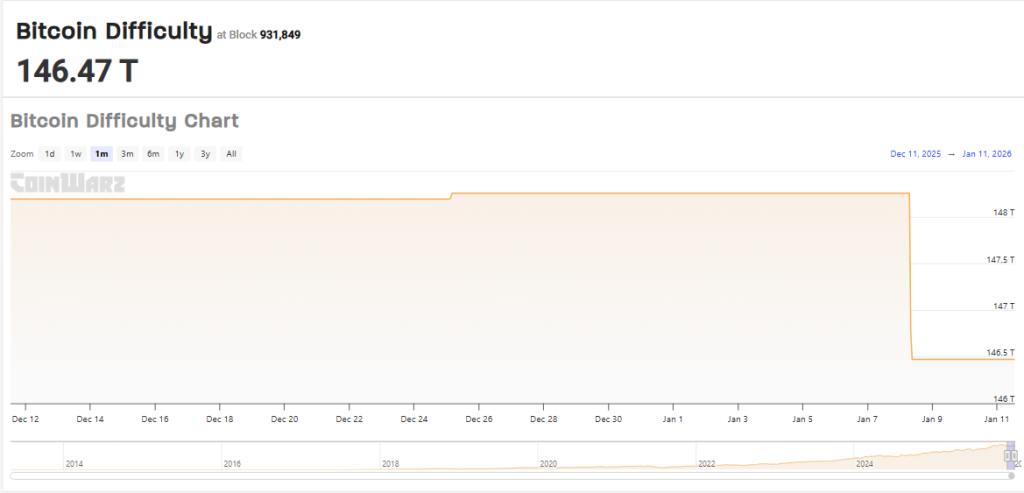
Source: CoinWarz
The next adjustment is scheduled for January 22nd.
Based on CoinWarz estimates and other trackers, the next difficulty recalculation is predicted on January 22, 2026, and could increase towards 148 trillion as the average block time slows towards the 10 minute goal. If this pattern holds true, the decrease in difficulty may be temporary and competition among miners may intensify again.
why numbers are important
Difficulty is a method built into the protocol to stabilize block generation. Difficulty changes every two weeks (2016 blocks) to match the total computational power securing the chain. The difficulty increases as more hashing power is added. If you drop or block too fast, the difficulty will be eased. These adjustments affect how quickly miners find blocks and the amount of work they need to perform to earn rewards.
Miners will focus on hash rate trends, power costs, and Bitcoin prices, as these factors will determine adjusted profitability over the next few days. On the other hand, while the market often moves smoothly through these technical adjustments, sustained movements in difficulty or hash power can signal broader changes in miner behavior that can impact supply dynamics over time.
According to the latest reports, the first adjustment in January lowered the difficulty to around 146.4T, with an average block time of 9.88 minutes. Some estimates suggest that if the situation changes as expected, it is likely to rise to around 148.20T around January 22nd. Officials argue that while the changes will give miners some breathing room, they will not alleviate the financial pressures many miners face until 2025.
Featured image from Unsplash, chart from TradingView
editing process for is focused on providing thoroughly researched, accurate, and unbiased content. We adhere to strict sourcing standards, and each page is carefully reviewed by our team of top technology experts and experienced editors. This process ensures the integrity, relevance, and value of your content to your readers.