






By using this site, you agree to the Privacy Policy and Terms of Use.
Accept
bitcoin
Bitcoin (BTC) $ 90,598.27
ethereum
Ethereum (ETH) $ 3,131.43
xrp
XRP (XRP) $ 2.08
tether
Tether (USDT) $ 1.00
solana
Solana (SOL) $ 133.01
bnb
BNB (BNB) $ 887.85
usd-coin
USDC (USDC) $ 1.00
dogecoin
Dogecoin (DOGE) $ 0.141604
cardano
Cardano (ADA) $ 0.451868
staked-ether
Lido Staked Ether (STETH) $ 3,131.06
tron
TRON (TRX) $ 0.281016
chainlink
Chainlink (LINK) $ 13.80
avalanche-2
Avalanche (AVAX) $ 13.66
wrapped-bitcoin
Wrapped Bitcoin (WBTC) $ 90,463.24
wrapped-steth
Wrapped stETH (WSTETH) $ 3,825.12
the-open-network
Toncoin (TON) $ 1.62
stellar
Stellar (XLM) $ 0.242815
hedera-hashgraph
Hedera (HBAR) $ 0.135136
sui
Sui (SUI) $ 1.61
shiba-inu
Shiba Inu (SHIB) $ 0.000009
weth
WETH (WETH) $ 3,132.23
leo-token
LEO Token (LEO) $ 9.55
polkadot
Polkadot (DOT) $ 2.13
litecoin
Litecoin (LTC) $ 84.30
bitget-token
Bitget Token (BGB) $ 3.57
bitcoin-cash
Bitcoin Cash (BCH) $ 585.29
hyperliquid
Hyperliquid (HYPE) $ 27.86
usds
USDS (USDS) $ 1.00
uniswap
Uniswap (UNI) $ 5.54
cryptoprune cryptoprune
  • MarketCap
  • Crypto Bubbles
  • Multi Currency
  • Evaluation
  • Home
  • News
  • Crypto
    • Altcoins
    • Bitcoin
    • Blockchain
    • Cardano
    • Ethereum
    • NFT
    • Solana
  • Market
  • Mining
  • Exchange
  • Regulation
  • Metaverse
Crypto PruneCrypto Prune
  • Home
  • News
  • Crypto
    • Altcoins
    • Bitcoin
    • Blockchain
    • Cardano
    • Ethereum
    • NFT
    • Solana
  • Market
  • Mining
  • Exchange
  • Regulation
  • Metaverse

Search

  • Home
  • News
  • Crypto
    • Altcoins
    • Bitcoin
    • Blockchain
    • Cardano
    • Ethereum
    • NFT
    • Solana
  • Market
  • Mining
  • Exchange
  • Regulation
  • Metaverse

Latest Stories

image
Aave’s ETH supply breaks record with over 3 million tokens
image
Horeb Energy and Veolia mine Bitcoin for 2.5 cents/kWh using Colombian landfill biogas
Argentina prepares to exempt crypto sector from taxes
image
Citi and Swift complete groundbreaking trial for fiat-to-digital currency payments
If an immortal AI starts saving forever in Bitcoin, what will happen to the money created for mortal humans?
© 2025 All Rights reserved | Powered by Crypto Prune
Crypto Prune > News > Crypto > Blockchain > Revealing how to optimize cryptography
Blockchain

Revealing how to optimize cryptography

2 months ago 3 Min Read

In a new paper, Ethereum co-founder Vitalik Buterin examines one of the most overlooked limitations in computing: memory access time, and how a deeper understanding of it could change the way cryptographic systems are developed. Although this subject seems highly technical, it relates directly to the potential efficiency of blockchain, cryptographic proofs, and even AI models.

Memory access issues

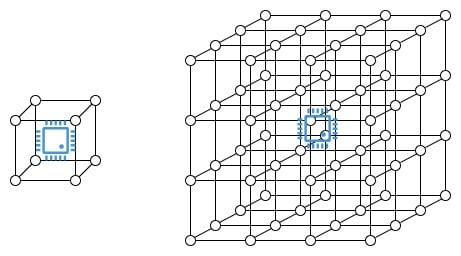
Buterin argues that it is a mistake to think that reading or writing to memory takes a fixed amount of time, as is often the case in computer science. Rather, he presents a model that proposes that the cube root of memory size determines memory access time. Simply put, retrieving data from memory becomes progressively slower as the data gets larger, as the signal has to physically travel longer distances.
Article image

He provides real-world evidence to support this, demonstrating that the time it takes to access data increases with memory size, from CPU cache to RAM, which is surprisingly consistent with his theoretical model. This recognition goes beyond simply pointing out academic niceties. It fundamentally changes the way we think about algorithm optimization, especially in the field of cryptography, where it is common to precompute and store intermediate results.

Solving blockchain memory management

Vitalik Buterin uses the example of elliptic curve cryptography, which is a fundamental part of blockchain security, to illustrate this point. To speed up the process, developers often precompute large numerical tables. However, the speed gain can be lost if the table grows too large to fit in cache memory due to speed degradation due to increased memory accesses. One of his tests found that a small cache fitting table was faster than a larger table held in RAM.

See also  Sony's Soneium debuts its scoring system and records on-chain participation

The conclusion is simple but profound. Cryptographic efficiency requires not only faster processors, but also more intelligent memory management. As the industry moves to specialized hardware such as ASICs and GPUs, understanding the principles he presents could help guide hardware optimization for future blockchain and zero-knowledge systems.

TAGGED:BlockchainBlockchain News
Leave a comment Leave a comment

Leave a Reply Cancel reply

Your email address will not be published. Required fields are marked *

RELATED NEWS

Spheron Network Joins Powers at Chainbase to Bridge AI with Blockchain Technology

Spheron Network Joins Powers at Chainbase to Bridge AI with Blockchain Technology

By Crypto Prune 6 months ago
AGI Open Network joins ORECAST to bring on-chain global mineral market

AGI Open Network joins ORECAST to bring on-chain global mineral market

By Crypto Prune 5 months ago
AGI Open Network collaborates with UnmarShal to incorporate efficient AI agents into Web3

AGI Open Network collaborates with UnmarShal to incorporate efficient AI agents into Web3

By Crypto Prune 5 months ago
New frontiers for crypto management

New frontiers for crypto management

By Crypto Prune 6 months ago
cryptoprune

© 2025 All Rights reserved | Powered by Crypto Prune

  • Altcoins
  • Bitcoin
  • Blockchain
  • Cardano
  • Ethereum
  • Exchange
  • Market
  • Metaverse
  • Mining
  • News
  • Crypto
  • NFT
  • Solana
  • Regulation
  • Technology
  • About Us
  • Contact Us
  • Disclaimer
  • Privacy Policy
  • Terms of Service
Welcome Back!

Sign in to your account

Lost your password?