









A Washington startup says the next frontier in computing, and perhaps Bitcoin mining, could orbit hundreds of miles above Earth.
Bitcoin mining goes to space as Starcloud prepares to launch Starcloud 2 satellite
Redmond-based space technology and artificial intelligence (AI) infrastructure company StarCloud is moving forward with plans to locate a data center in low Earth orbit, a plan that aims to harness the continuous solar energy and natural cooling properties of space, while also hinting at the possibility of mining Bitcoin outside of Earth’s atmosphere, PCMag reports.
The company launched StarCloud 1 on a SpaceX Falcon 9 rocket in November 2025, proving its concept for the first time. For the first time, a small satellite the size of a refrigerator is equipped with five Nvidia H100 processors>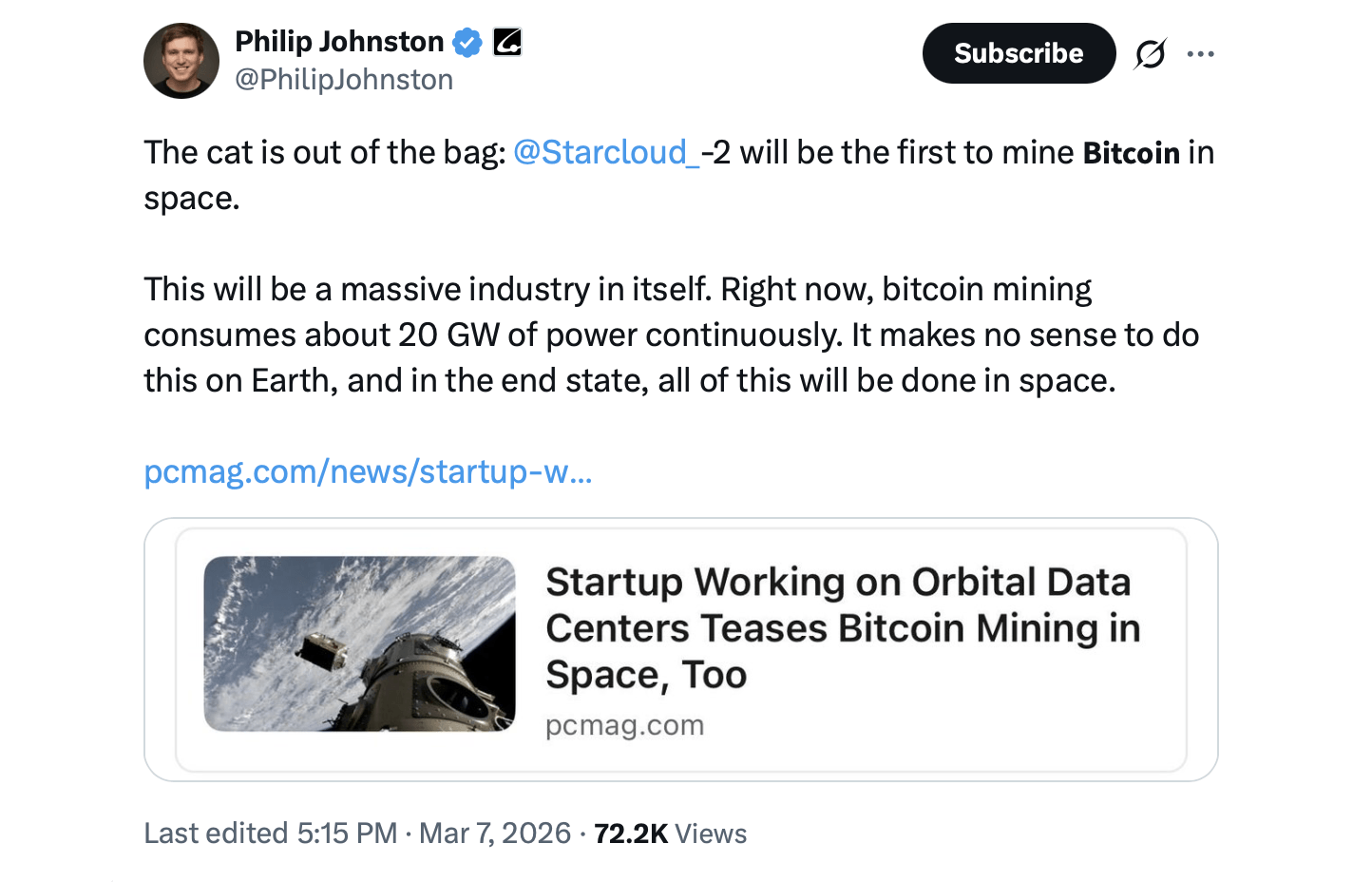
Image source: X
The company is currently preparing a larger tracking satellite. CEO Philip Johnston said Starcloud-2, scheduled to launch in late 2026, will feature a much larger cluster of GPUs, along with specialized Bitcoin mining hardware known as ASICs (Application-Specific Integrated Circuits).
“There’s also Bitcoin mining… we’re planning to have a Bitcoin mining ASIC in the second device that launches later this year,” Johnston said in an interview with PCMag. “We think we can be the first to mine coins in space.”
This concept is based on two advantages unique to orbit. Satellites located in sun-synchronous orbits can receive near-constant sunlight, eliminating most of the night cycles and weather disturbances that affect solar power generation on Earth. At the same time, the vacuum of space would act as a giant heat sink, allowing radiators to release waste heat directly into space without the use of water-intensive cooling systems.
Starcloud claims that this situation has the potential to significantly reduce energy costs. The company estimates that orbital data centers can operate at approximately one-tenth lower energy costs than traditional facilities, while reducing lifetime carbon emissions as well.
To support that vision, the startup has filed paperwork with the Federal Communications Commission (FCC) seeking approval for a constellation of 88,000 satellites dedicated to orbital computing infrastructure. Johnston outlined a long-term goal of building a 5-gigawatt orbital data center supported by a huge solar array spanning several kilometers.
Bitcoin mining is framed as an early test case for the energy model. Mining hardware is much cheaper than high-end AI processors and can monetize surplus power generated by solar arrays in orbit.
ASIC mining machines often cost hundreds to thousands of dollars each, compared to tens of thousands of dollars for advanced AI GPUs. Mining primarily converts electricity into cryptographic calculations, making it a natural fit for extraterrestrial power generation due to the steady availability of solar energy.
The idea of mining Bitcoin in space has been circulating for years, but StarCloud’s plan is one of the first publicly disclosed hardware deployments aimed at proving the concept. Another startup, Intercosmic Energy, has proposed a roadmap for a solar-powered orbital mining system, but has not yet begun operating the hardware.
Declining launch costs have revived interest in the concept. Modern rockets are steadily reducing the cost per kilogram of payload they carry into orbit, making it more practical to deploy computing hardware and large solar arrays on Earth.
At the same time, the efficiency gains in mining hardware are slowing down compared to before. Longer replacement cycles mean ASICs can be kept in use for longer periods of time, potentially improving the economics of operating in space.
Despite the excitement, this approach faces major hurdles. Space hardware must also withstand exposure to radiation, temperature fluctuations, and potential collisions with debris. Satellite reliability also remains a concern, with one of Starcloud-1’s GPUs reportedly failing before launch.
Regulators and environmental groups are also watching closely. Large constellations raise questions about orbital crowding and the risk of cascading debris events, sometimes called Kessler syndrome.
Even within the technology industry, there remains skepticism about its near-term feasibility. Critics argue that maintaining high-performance computing systems in orbit could pose logistical challenges that outweigh the energy benefits, at least initially.
Still, interest in orbital computing is growing rapidly. Companies like SpaceX, Blue Origin, and Axiom Space have all outlined plans for orbital infrastructure that can support computing workloads.
Market predictions suggest that orbital title=”Learn about Bitcoin Mining” target=”_blank”>Bitcoin mining is a demonstration, not a destination. By running ASICs in parallel with AI hardware, the company hopes to demonstrate that permanent on-orbit solar power can support both emerging AI workloads and energy-intensive cryptographic operations.
If the StarCloud 2 mission is successful later this year, the first Bitcoin mined in space could arrive sooner than most expected, marking another milestone at the growing intersection of space technology and digital infrastructure.
Frequently asked questions 🛰️
- What is Starcloud?Starcloud is a Washington-based startup that uses solar energy to develop data centers in low Earth orbit.
- Does Bitcoin mining actually take place in space?StarCloud says its StarCloud 2 satellite, scheduled to launch in 2026, will be equipped with ASIC hardware designed to mine Bitcoin.
- Why mine Bitcoin in space?With constant solar energy and vacuum cooling, orbital computing could be much cheaper and more energy efficient.
- When will the first Bitcoin be mined in orbit?If the StarCloud 2 mission is successful, the first space-mined Bitcoin could be created as early as the end of 2026.