









Bitcoin miners are finally taking a breather as hash price rises from the basement after hitting a severe low just a few days ago that put operations under stress. Despite this drop in revenue, the network’s hashrate has maintained its position, hovering within a narrow band between 1,050 exahashes per second (EH/s) and 1,100 EH/s.
Miners welcome hash price rebound
The recent rise in Bitcoin prices has given BTC miners a much-needed breath of fresh air after weeks of declining income. On the last day of November, Hashprice bottomed out at $36.35 per petahash per second (PH/s), according to numbers from hashrateindex.com.
Simply put, hash price is the sticker price of 1 petahash of computing power, which is essentially the price that a miner expects for all of its output. Just a few days later, on December 1st, the hash price was still depressed at $35.85 per petahash. The latest price movement over the past day reversed the scenario, with miners pulling in around $39.79 per PH/s as the hash price inched back towards the $40 zone.
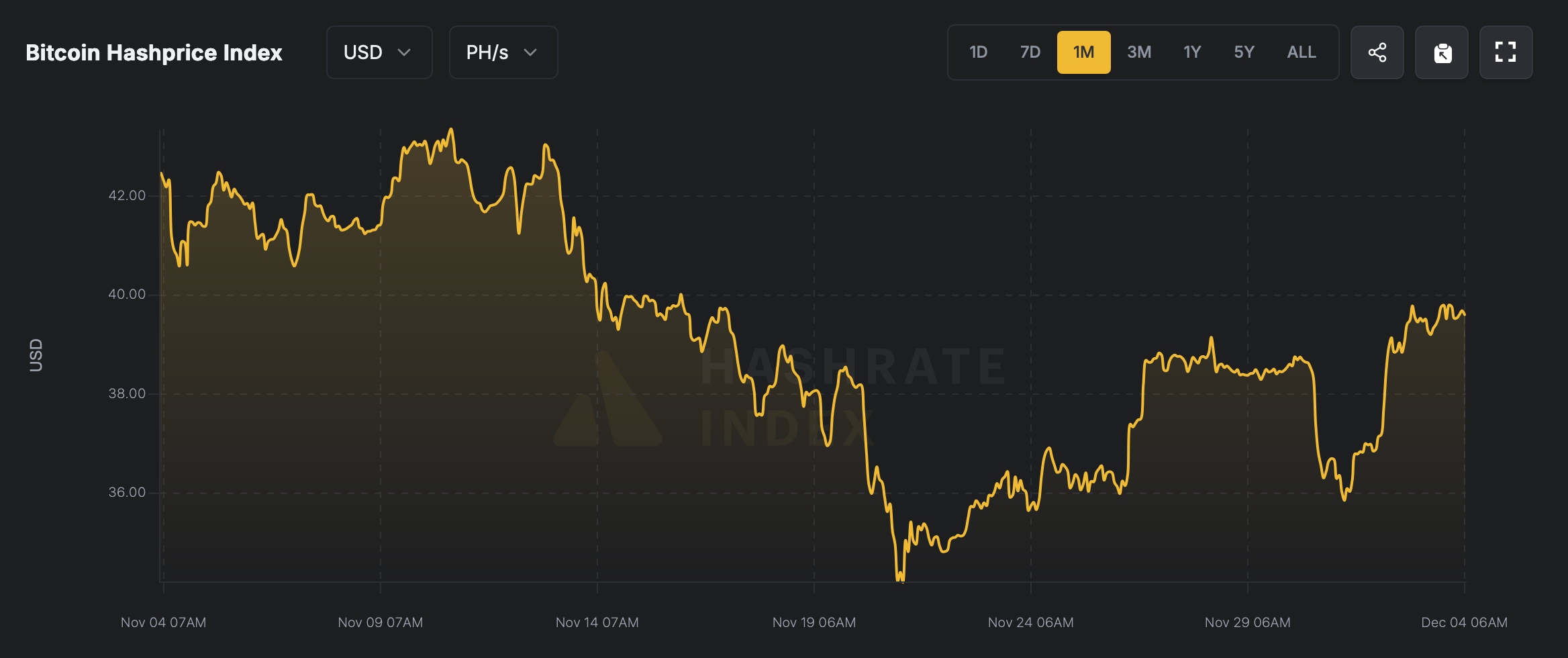
Bitcoin hash price for the last 30 days.
Despite the drop in daily returns, Bitcoin’s overall hashrate has remained solidly above the 1 ZettaHash/Second (ZH/s) mark for quite some time, and has never fallen below that threshold in years. Thanks to that stability, the block spacing has remained relatively uneventful, so the expected difficulty adjustments on December 11th may not be much of a relief.
At the moment, miners still have about half of the 2,016 block difficulty epoch left, so things could change, but current estimates indicate a modest decline of 1.34%. The block interval was slightly behind the target of 10 minutes, averaging about 10 minutes and 8 seconds on Wednesday. If returns improve, block times could accelerate as hashrate increases, and difficulty epoch estimates could easily change accordingly.
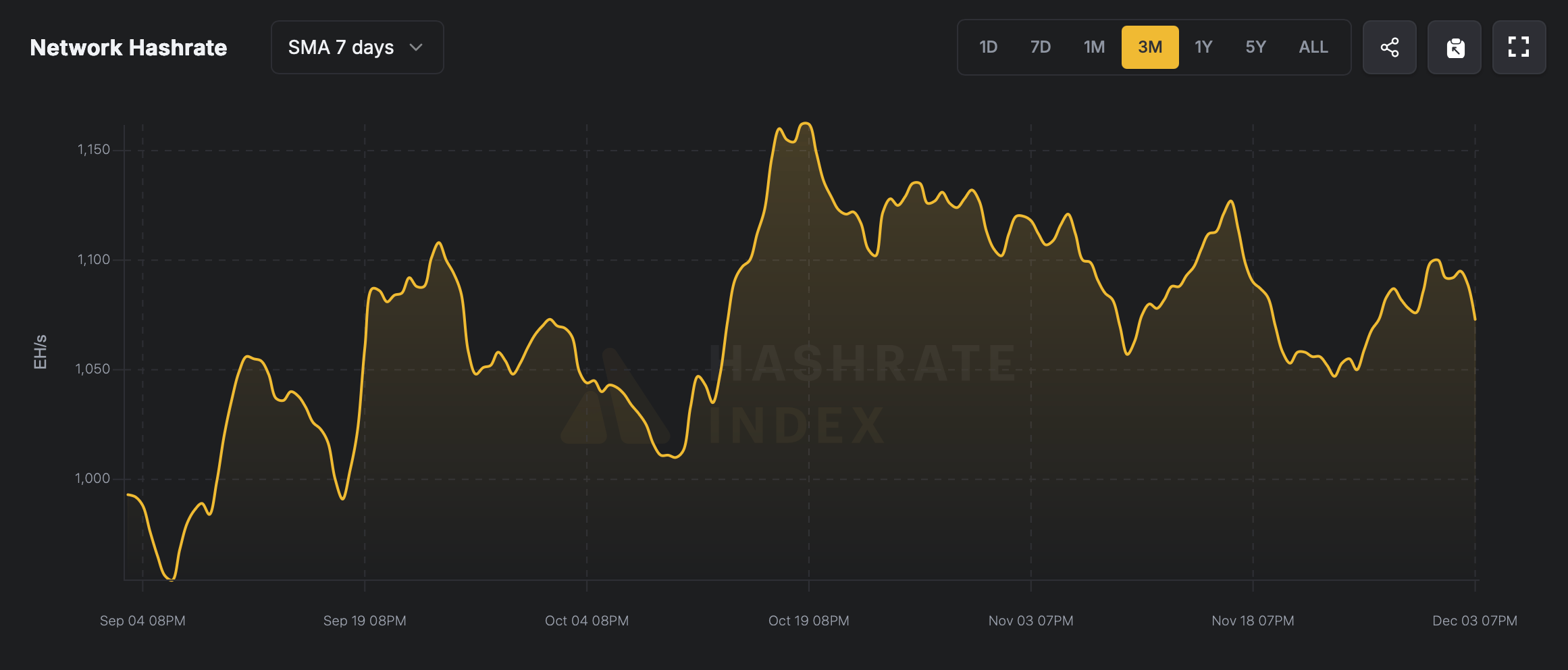
Bitcoin hashrate over the past 3 months.
At today’s hash price level, the indicator is still 7.98% below its level from 30 days ago. On top of that, November ranked as the fourth weakest month for miner revenue in 2025. Miners can overcome this predicament in a variety of ways, and being publicly traded is a huge advantage. Companies outside the civilian realm have relied heavily on debt financing to build up their military this year, with many pivoting deeper into artificial intelligence (AI) and high-performance computing (HPC) services.
read more: Charles Schwab plans to expand crypto trading in the first half of 2026
AI and HPC have powered many Bitcoin mining operations by injecting additional revenue streams. Finally, Bitcoin mining equipment continues to level up, with manufacturers pushing the limits of application-specific integrated circuit (ASIC) performance. Today’s machines are capable of more than 0.5 petahash (1,000 terahash per second), and a full 1 PH/s unit is already within reach.
Overall, the sector is tottering on narrow profit margins due to a combination of grit, innovation and borrowed oxygen, but miners are never going to stand still. With stable hash prices, diversified revenue streams, and the horsepower of next-generation ASICs, miners are enjoying some old-fashioned luck.
Frequently asked questions ❓
- What is Hash Price?Hash price measures how much revenue miners earn for each petahash (or TH/s or EH/s) of computational power.
- Why has miner revenue decreased recently?Revenues have cooled as Bitcoin prices have weakened and hash prices have fallen to their lowest levels this year.
- How do miners survive?Many miners have turned to debt financing, AI services, and high-performance computing (HPC) to increase their incomes.
- Are mining machines becoming more efficient?Yes, manufacturers have been rolling out more powerful ASIC rigs all year long, with half-petahash units now common, and 1 PH/s models also on the way.